Landowners Meetings and Board Elections

On January 4, 2023, the LWDD will hold the Annual Landowners Meeting at the District’s office at 9:00 a.m. The Landowners Meeting is open to the public. The purpose is for the hearing of reports, comments from landowners and the election of Board Supervisors. Qualified candidates in this election cycle are Carrie Parker Hill for Sub-District 4 and Stephen Bedner for Sub-District 2. For more information about the Landowners Meeting and the election process click the link below

rocess click here.

Holiday Time Is Water Conservation Time

During the holidays, water plays a role in everything from food preparation to the cleanup process. Here’s how to incorporate water conservation into your holiday preparations:

  • Defrost frozen foods in the refrigerator or the microwave instead of running hot water over them.
  • Rinse vegetables and fruits in a sink or pan filled with water instead of under running water. This water can then be reused to water houseplants. A running faucet can use up to 4 gallons per minute.
  • When washing dishes by hand, fill one sink or basin with soapy water and fill the rinsing sink one-third to one-half full. Avoid letting the water run continuously in the rinsing sink.
  • Select the proper size pans for cooking. Large pans require more cooking water than may be necessary.
  • Scrape food scraps into the garbage can or a composting bin, rather than rinsing them into the sink’s garbage disposal. A garbage disposal uses up to 4.5 gallons of water per minute.
  • Run your dishwasher only when you have a full load. Dishwashers use between 7 and 12 gallons per load.
  • Remind overnight house guests to limit their shower time to 5 minutes to conserve water.
  • Choose an artificial Christmas tree since they do not require water, are not a fire hazard and preserve our tree canopies.

Don’t let the busy holiday season keep you from practicing good water conservation habits.

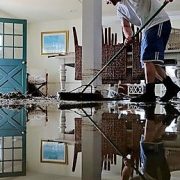
What Is A Flash Flood? A Civil Engineer Explains

The Conversation, August 2, 2022

Janey Camp, Research Professor of Civil and Environmental Engineering, Vanderbilt University

Flash flooding is a specific type of flooding that occurs in a short time frame after a precipitation event – generally less than six hours. It often is caused by heavy or excessive rainfall and happens in areas near rivers or lakes, but it also can happen in places with no water bodies nearby.

Flash floods happen in rural and urban areas, as in late July 2022 in St. Louis and eastern Kentucky. When more rainfall lands in an area than the ground can absorb, or it falls in areas with a lot of impervious surfaces like concrete and asphalt that prevent the ground from absorbing the precipitation, the water has few places to go and can rise very quickly.

If an area has had recent rainfall, the soil may be saturated to capacity and unable to absorb any more water. Flooding can also occur after a drought, when soil is too dry and hardened to absorb the precipitation. Flash floods are common in desert landscapes after heavy rainfalls and in areas with shallow soil depths above solid bedrock that limits the soil’s ability to absorb rain.

Since water runs downhill, rainfall will seek the lowest point in a potential pathway. In urban areas, that’s often streets, parking lots and basements in low-lying zones. In rural areas with steep terrain, such as Appalachia, flash flooding can turn creeks and rivers into raging torrents.

Flash floods often catch people by surprise, even though weather forecasters and emergency personnel try to warn and prepare communities. These events can wash away cars and even move buildings off their foundations.

The best way to stay safe in a flash flood is to be aware of the danger and be ready to respond. Low-lying areas are at risk of flooding, whether it happens slowly or quickly and whether it’s an urban or rural setting.

It’s critical to know where to get up-to-date weather information for your area. And if you’re outdoors and encounter flooded spots, such as water-covered roadways, it is always safer to wait for the water to recede or turn back and find a safer route. Don’t attempt to cross it. Flood waters can be much faster and stronger than they appear – and therefore more dangerous.

Engineers design stormwater control systems to limit the damage that rainfall can do. Culverts transfer water and help control where it flows, often directing it underneath roads and railways so that people and goods can continue to move safely. Stormwater containment ponds and detention basins hold water for release at a later time after flooding has ceased.

Many cities also are using green infrastructure systems, such as rain gardens, green roofs and permeable pavement, to reduce flash flooding. Restoring wetlands along rivers and streams helps mitigate flooding as well.

Often the design standards and rules that we use to engineer these features are based on historic rainfall data for the location where we’re working. Engineers use that information to calculate how large a culvert, pond or other structure might need to be. We always build in some excess capacity to handle unusually large floods.

Now, however, many parts of the U.S. are experiencing more intense storm events that drop significant amounts of rainfall on an area in a very short time period. The recent St. Louis and Kentucky floods were both on a scale that statistically would be expected to occur in those areas once in 1,000 years.

With climate change, we expect this trend to continue, which means that planners and engineers will need to reconsider how to design and manage infrastructure in the future. But it’s hard to predict how frequent or intense future storm events will be at a given location. And while it’s extremely likely that there will be more intense storm events based upon climate projections, designing and building for the worst-case situation is not cost effective when there are other competing demands for funding.

Right now, engineers, hydrologists and others are working to understand how best to plan for the future, including modeling flood events and development trends, so that we can help communities make themselves more resilient. That will require more, updated data and design standards that better adapt to anticipated future conditions.

Board Supervisors Carrie Parker Hill

Carrie Parker HillFollowing Harry Raucher’s retirement from the Board in October 2022, Carrie Parker Hill was appointed to serve on the Board of Supervisors as an interim board member beginning November 2022. She will serve the remainder of the term for the Sub-District 4 seat which expires in January 2023. The Sub-District 4 region generally includes the area located south of Lantana Road and north of Delray West Road (W. Atlantic Avenue), between the Florida Turnpike and I-95.
Ms. Hill is a candidate for election for the Sub-District 4 seat at the Annual Landowners Meeting on January 4, 2023.

Ms. Hill is a seasoned professional with more than 40 years of experience in public sector management, specializing in coalition building, finance and budget management, and labor relations. During her distinguished career, she served as the City Manager for Boynton Beach, Village Manager for the Village of Golf, and Assistant Deputy Executive Director of Corporate Resources for the South Florida Water Management District. Ms. Hill is a University of Florida alumni where she earned her Bachelor of Science in Business Administration and Master of Arts in Political Science & Public Administration.

Ms. Hill is a resident of the Delray Dunes neighborhood where she currently serves as the HOA President. She is active in the community and has served as a Board member on the Palm Beach County School Board, Arthur R. Marshall Foundation for the Everglades, and Children Services Council of Palm Beach County.

Droughts Self-propagate, Just Like Wildfires

Excerpt from Ghent University on the Phys.org website

Up to 30% of the rainfall deficit can be caused by “drought self-propagation,” the DRY–2–DRY European Research Council (ERC) project shows.

Unlike other weather extremes such as hurricanes or winter storms, droughts affect humans in most climatic zones around the world; from the arid steppes of the Sahel to the humid rainforests of Amazonia. Moreover, droughts are expected to intensify in many regions following global warming. The United Nations has recently described drought as “the next pandemic,” suggesting that the associated risks are currently overlooked. It is thus crucial to improve our understanding of drought, and particularly its causes, in order to be able to predict its future risk and enable adequate societal adaptation.

Rainfall deficits eventually manifest as dry soils. The land surface, though, also takes a very active role in the generation of rainfall, as it supplies moisture to the atmosphere through evaporation. What happens during a soil drought when far less water is evaporated than usual? It has been hypothesized that this can enable droughts to expand by themselves, as they provide less moisture for precipitation, not just locally, but also downwind. Until now, evidence of this drought self-propagation, fueled by the drying soils, had remained elusive. In a new study, published in Nature Geoscience, led by the Hydro-Climate Extremes Lab (H-CEL) at Ghent University (Belgium), this evidence is provided for the first time.

The authors analyzed the largest 40 droughts in recent history. For each event, the authors tracked the air over the drought regions as the drought area expanded. This allowed them to compute how much of the downwind rainfall deficits were caused by the upwind drying of the soils. Their conclusion was that in individual months, up to 30% of the rainfall deficit can be caused by this drought self-propagation. As Dominik Schumacher, first author of the study, states: “In essence, droughts behave similarly to wildfires: while fires propagate downwind by igniting more and more ‘fuel’ in their surroundings, droughts do so by reducing their own rainfall supply through the drying of the land surface.”

The authors find the strongest self-propagation in subtropical drylands, such as in Australia and Southern Africa—in these regions, the limiting effect of low soil moisture on evaporation is strongest. By definition, water is already scarce in drylands, yet these regions sustain a considerable fraction of the global human population and are also used extensively for farming.

Therefore, as drylands are projected to expand in light of climate change, the self-propagating character of droughts may lead to even larger and more rapidly evolving events in the future, and further exacerbate water scarcity as well as the attached socioeconomic and environmental consequences.

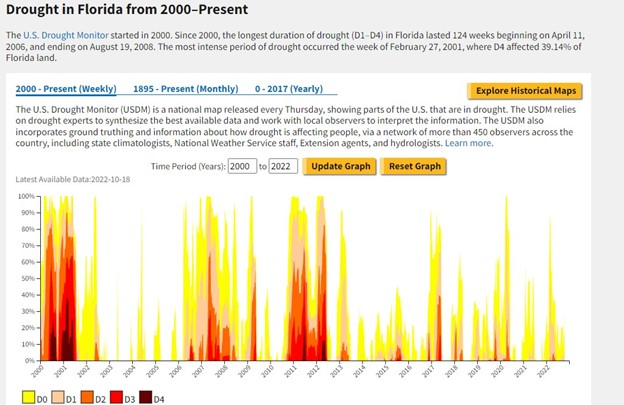
To find out more about current and historical droughts in Florida visit www.drought.gov/states/florida

Graph of drought in Florida from 2000 to present